
Music Market to Reach USD 57.74 Billion by 2032 as Streaming, Digital Distribution, and Licensing Revenues Expand
Hyderabad, India – November 03, 2026
Music Market Overview
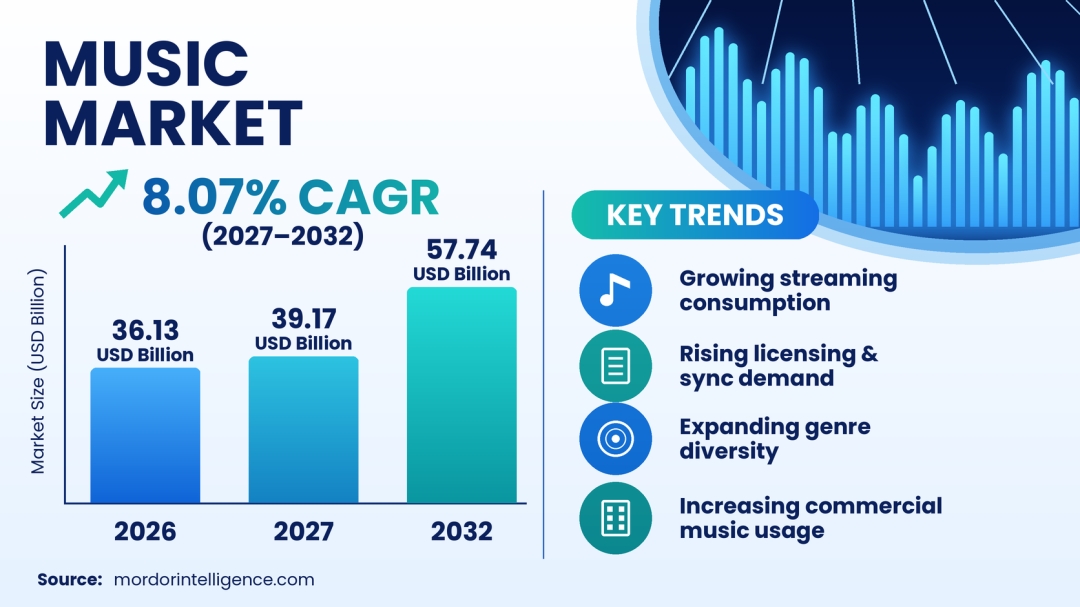
The Music market size is projected to expand from USD 36.13 billion in 2026 to USD 39.17 billion in 2027 and reach USD 57.74 billion by 2032, registering a CAGR of 8.07% between 2027 and 2032. The market includes revenue generated through music streaming, digital downloads, physical products, performance rights, synchronization revenues, merchandising, and licensing. Changing listening preferences and the increasing use of online platforms are influencing how consumers discover, access, and purchase music. Streaming services have become an important distribution channel, while physical music products and commercial licensing continue to serve specific consumer and business requirements.
The music industry operates through a combination of record labels, music publishers, streaming platforms, distributors, artists, and rights management companies. Revenue generation depends on consumer subscriptions, advertising-supported listening, music sales, public performance rights, and the use of licensed recordings across films, television, gaming, advertising, and commercial establishments. The Music market trends also reflect the growing importance of genre diversity, digital distribution, and licensing arrangements. These developments influence the competitive environment and create opportunities for companies operating across different music formats and distribution channels.
Key Trends in the Music Market
Growing Streaming Consumption Supports Digital Music Revenues
Online streaming continues to play an important role in music distribution as listeners increasingly access songs, albums, playlists, and podcasts through digital platforms. Subscription-based and advertising-supported services provide different listening options for individual consumers. Streaming platforms also allow music companies and artists to reach audiences across geographical markets without depending entirely on physical distribution. Personalised playlists, music recommendations, and on-demand listening contribute to regular platform engagement. This shift supports Music market growth while encouraging rights holders and distributors to develop commercial arrangements around digital music consumption.
Rising Demand for Music Licensing and Synchronization Revenues
Music licensing provides revenue opportunities beyond direct consumer purchases and streaming subscriptions. Film and television producers, gaming companies, brands, advertisers, and event organisers use licensed music to support their content and commercial activities. Synchronization revenues are generated when music is licensed for use alongside visual media, while performance rights provide income when music is publicly performed or played in commercial environments. These revenue streams allow rights holders and music publishers to monetise recordings and compositions across different applications. The growing use of licensed music across entertainment and commercial settings contributes to the Music market share landscape.
Expanding Genre Diversity Broadens Audience Participation
Music consumption spans multiple genres, including pop, rock, hip-hop and rap, electronic and dance, classical, jazz, country, and Latin music. Different genres attract distinct audiences and listening preferences, allowing platforms and record labels to serve a broad consumer base. Online distribution also enables listeners to discover music from different regions and musical backgrounds. This variety supports the availability of specialised playlists, genre-focused catalogues, and targeted promotional activities. Music companies use these distribution opportunities to connect artists with audiences and strengthen their presence across different consumer segments.
Increasing Commercial Music Usage Supports Multiple Revenue Channels
Commercial establishments, media producers, brands, and event organisers represent important users of music beyond individual consumers. Bars, hotels, and retail businesses use music in customer-facing environments, while film, television, and gaming producers require licensed recordings and compositions for their productions. Brands and advertisers also use music in promotional campaigns, and concert organisers generate revenue through live performances and related activities. These applications create demand for performance rights, synchronization, merchandising, and licensing arrangements. The Music market forecast reflects the contribution of these varied revenue sources to the industry’s long-term development.
Check out more details and stay updated with the latest industry trends, including the Japanese version for localized insights:
https://www.mordorintelligence.com/ja/industry-reports/music-market-landscape?utm_source=abnewswire
Music Market Segmentation
The market is segmented by revenue generation format, genre, distribution channel, end user, and geography.
-
By Revenue Generation Format
-
Streaming
-
Digital Downloads (ex-Streaming)
-
Physical Products
-
Performance Rights
-
Synchronization Revenues
-
Merchandising and Licensing
-
-
By Genre
-
Pop
-
Rock
-
Hip-Hop / Rap
-
Electronic / Dance
-
Classical
-
Jazz
-
Country
-
Latin
-
-
By Distribution Channel
-
Online Platforms
-
Offline / Brick-and-Mortar Retail
-
-
By End User
-
Individual Consumers
-
Commercial Establishments (bars, hotels, retail)
-
Media and Entertainment Producers (film, TV, gaming)
-
Brands and Advertisers
-
Event and Concert Organizers
-
-
By Geography
-
North America
-
United States
-
Canada
-
Mexico
-
-
South America
-
Brazil
-
Argentina
-
Rest of South America
-
-
Europe
-
Germany
-
United Kingdom
-
France
-
Spain
-
Italy
-
Russia
-
Rest of Europe
-
-
Asia Pacific
-
China
-
Japan
-
India
-
South Korea
-
Australia and New Zealand
-
Rest of Asia Pacific
-
-
Middle East and Africa
-
Middle East
-
United Arab Emirates
-
Saudi Arabia
-
Turkey
-
Rest of Middle East
-
-
Africa
-
South Africa
-
Egypt
-
Rest of Africa
-
-
-
Explore Our Full Library of Technology Media and Telecom Research:
https://www.mordorintelligence.com/market-analysis/technology-media-and-telecom?utm_source=abnewswire
Music Market Key Players
The competitive landscape includes international music companies involved in recorded music, music publishing, rights management, distribution, and licensing. BMG Rights Management GmbH and Kobalt Music Group Ltd. participate in music rights management and publishing activities, helping songwriters and rights holders manage and commercialise their musical works. Their operations cover areas such as royalty administration, publishing services, and licensing arrangements.
Sony Music Entertainment (Sony Corporation of America), Universal Music Group N.V., and Warner Music Group Corp. are major participants in the global recorded music and music publishing landscape. These companies work with artists, songwriters, and other industry participants across recording, distribution, and rights management activities. Their catalogues and commercial relationships support revenue generation through streaming, physical products, licensing, and performance-related channels. Competition among established music companies also involves artist development, catalogue management, distribution partnerships, and relationships with digital platforms.
Explore more insights on music competitive landscape:
Conclusion
The Music market continues to develop through changing listening habits, wider digital distribution, and multiple revenue generation formats. Streaming remains an important channel for connecting consumers with recorded music, while digital downloads, physical products, performance rights, synchronization, and licensing provide additional commercial opportunities. Genre diversity and the use of music across entertainment and commercial establishments further support the industry’s broad customer base.
Companies operating in the Music industry are positioned across different parts of the value chain, including recording, publishing, rights management, and distribution. Their ability to manage music catalogues, develop artist relationships, and establish licensing arrangements remains relevant to their competitive position. The Music market forecast reflects continued opportunities across distribution channels, end users, and geographical markets as music consumption and commercial applications develop.
About Mordor Intelligence:
Mordor Intelligence is a global market intelligence firm, founded in 2014, helping businesses make informed decisions through data-driven insights, industry expertise, and advanced analytics. With 550+ domain experts and on-ground specialists across 150+ countries, the company delivers comprehensive intelligence across aerospace & defense, agriculture, automation, automotive, chemicals & materials, consumer goods & services, electronics, energy & power, financial services, food & beverages, healthcare, hospitality & tourism, information & communications technology, and logistics.
Its offerings include syndicated industry reports, custom research and advisory, and subscription platforms such as Synapse, Data Center Intelligence, and Robotics Intelligence.Mordor Intelligence is ISO 9001:2015 and ISO/IEC 27001:2022 certified, a member of ESOMAR and the Market Research Society of India, and a four-time Great Place to Work® honoree.Learn more at mordorintelligence.com.
Media Contact
Company Name: Mordor Intelligence Private Limited
Contact Person: Jignesh Thakkar
Email: Send Email
Phone: +1 617-765-2493
Address:11th Floor, Rajapushpa Summit, Nanakramguda Rd, Financial District, Gachibowli
City: Hyderabad
State: Telangana 500008
Country: India
Website: https://www.mordorintelligence.com/


